Can I Deduct My Truck? New 2026 Tax Rules for Contractors
Yes, you can deduct your truck — but how much depends on whether it is over 6,000 pounds, how you use it, and whether you track your miles. For 2026, the Section 179 deduction lets you write off up to $1,220,000 on qualifying vehicles used more than 50% for business, and heavy trucks (over 6,000 lbs GVWR) can avoid luxury vehicle caps entirely. The key is documentation: without a mileage log or proof of business use, the IRS will disallow the deduction and you will owe back taxes plus penalties.
If you are a contractor reading this at 11pm because you just bought a truck and your buddy said it is 'totally deductible,' this article is for you. We are going to break down exactly what the IRS allows in 2026, what triggers an audit, and how to set up a system so you never lose a deduction you deserve.
What Changed for Vehicle Deductions in 2026?
The Section 179 deduction limit increased to $1,220,000 for 2026, up from $1,160,000 in 2025. This is the total amount you can deduct across all qualifying equipment and vehicles in a single year. Bonus depreciation, which used to let you write off even more, dropped to 40% in 2024 and is now completely phased out as of 2026. That means Section 179 is your main tool for immediate deductions on vehicles.
For contractors, this matters because trucks are expensive and you need them to work. A new F-250 can run $70,000. A Ram 3500 with a utility bed might be $80,000. If you finance that over five years, you are paying $1,400 a month — but the tax deduction happens up front if you structure it right. The catch is that not all vehicles qualify the same way, and the IRS has specific rules about what counts as a 'heavy' vehicle versus a 'luxury' vehicle.
Here is what you need to know: vehicles under 6,000 pounds GVWR (Gross Vehicle Weight Rating) are subject to luxury vehicle caps, which limit your first-year deduction to around $20,000 even if you use Section 179. Vehicles over 6,000 pounds GVWR — like most 3/4-ton and 1-ton trucks — can be fully deducted under Section 179 with no cap, as long as they are used more than 50% for business. This is why your accountant keeps asking about the GVWR sticker on the driver's side door frame.
How Do I Know If My Truck Qualifies for the Full Deduction?
Step one: Find the GVWR on the sticker inside the driver's side door. This is the manufacturer's maximum weight rating for the vehicle, including passengers and cargo. If that number is over 6,000 pounds, you are in the clear for Section 179 with no caps. Most F-250s, Ram 2500s, Silverado 2500s, and anything bigger qualify. Most F-150s, Ram 1500s, and Silverado 1500s do not — they usually come in just under 6,000 pounds and get hit with the luxury vehicle limits.
Step two: Prove business use over 50%. The IRS requires that the vehicle is used more than half the time for business to qualify for Section 179. If you use the truck 60% for business and 40% for personal trips, you can deduct 60% of the vehicle cost. If it is 50% or less, you cannot use Section 179 at all — you are stuck with standard depreciation, which spreads the deduction over five years.
Here is a real example: You are a plumbing contractor and you buy a 2026 Ram 3500 crew cab with a service body for $78,000. The GVWR is 11,500 pounds. You use it to drive to job sites, haul tools, pick up materials, and occasionally drive it home on weekends. You track your miles for three months and find that 80% of your trips are business-related. You can deduct $62,400 in the first year ($78,000 × 80%) using Section 179. That deduction drops your taxable income by $62,400, which at a 30% effective tax rate saves you about $18,700 in taxes in year one.
Step three: Keep a mileage log. This is the part that gets contractors in trouble. The IRS does not care what you 'probably' used the truck for — they want a contemporaneous log. That means a record made at the time of the trip, not reconstructed in April when your accountant asks for it. You do not need to log every single trip if the truck is used 100% for business and never driven home, but if there is any personal use, you need proof of the split. Apps like MileIQ, Everlogs, or even a simple spreadsheet work. Write down the date, starting and ending odometer reading, destination, and purpose. Do this for at least 90 days to establish a pattern, then you can use that percentage for the full year.
What If I Already Bought the Truck in 2025 — Can I Still Deduct It?
If you bought and started using the truck in 2025, you deduct it on your 2025 tax return, not 2026. But if you bought it in late 2025 and did not put it in service until 2026, the deduction happens in 2026. 'Placed in service' means you started using it for business — not just the day you signed the paperwork.
If you financed the truck, that does not change anything. You can still take the full Section 179 deduction in year one even if you are making payments over five years. The IRS does not care how you paid for it — they care when you started using it for business. This is a huge advantage for cash flow. You get a $60,000 deduction in year one, but you only paid $12,000 out of pocket (down payment plus a few months of payments). The tax savings can cover a big chunk of your first-year payments.
One warning: If you trade in your old truck, the trade-in value reduces your basis in the new truck. Let us say you buy a $78,000 truck and trade in your old one for $15,000. Your basis is $63,000, and that is the amount you deduct — not $78,000. Your accountant should handle this automatically, but double-check the numbers on your return.
What About Leasing vs. Buying — Which Is Better for Deductions?
Leasing is simpler but usually costs you more over time. When you lease, you deduct the business-use percentage of your monthly lease payment. If your lease is $900 a month and you use the truck 80% for business, you deduct $720 per month, or $8,640 per year. You do this every year for the length of the lease. No mileage log drama, no depreciation schedules, just a straightforward expense deduction.
Buying with Section 179 gives you a huge deduction up front, but it requires more paperwork and you are on the hook for maintenance, repairs, and resale value. For most contractors, buying makes more sense if you plan to keep the truck for five-plus years and you have the taxable income to absorb the deduction. Leasing makes sense if you like getting a new truck every three years or if your taxable income is inconsistent and you want steady deductions.
Here is the math on a real scenario: You are an HVAC contractor doing $1.2 million in revenue with about $150,000 in taxable income. You buy a $75,000 truck and take a $75,000 Section 179 deduction. That drops your taxable income to $75,000, saving you about $22,500 in taxes (at 30%). Compare that to leasing the same truck for $1,000 a month with 80% business use. You deduct $9,600 per year. Over three years, that is $28,800 in deductions, saving you about $8,640 in taxes. The up-front deduction wins if you have the income to use it.
One catch: If you sell the truck within five years and your business use drops below 50% in any of those years, the IRS can 'recapture' part of your Section 179 deduction and you will owe taxes on it. This is rare, but it is why your accountant will tell you not to turn your work truck into a personal vehicle two years after you buy it.
What Records Do I Actually Need to Keep?
The IRS audits vehicle deductions more than almost anything else, because they know contractors use trucks for both business and personal use and the line gets blurry. Here is what you need in your file to survive an audit:
- A mileage log showing business vs. personal use for at least a 90-day representative period each year
- Receipts for the truck purchase or lease agreement
- Proof the vehicle was placed in service (insurance card, registration, first job invoice showing the truck in use)
- Records of repairs, fuel, insurance, and other vehicle expenses if you are deducting actual expenses instead of standard mileage
- Photos of the truck with your company logo if it is a clearly marked work vehicle (this helps prove 100% business use)
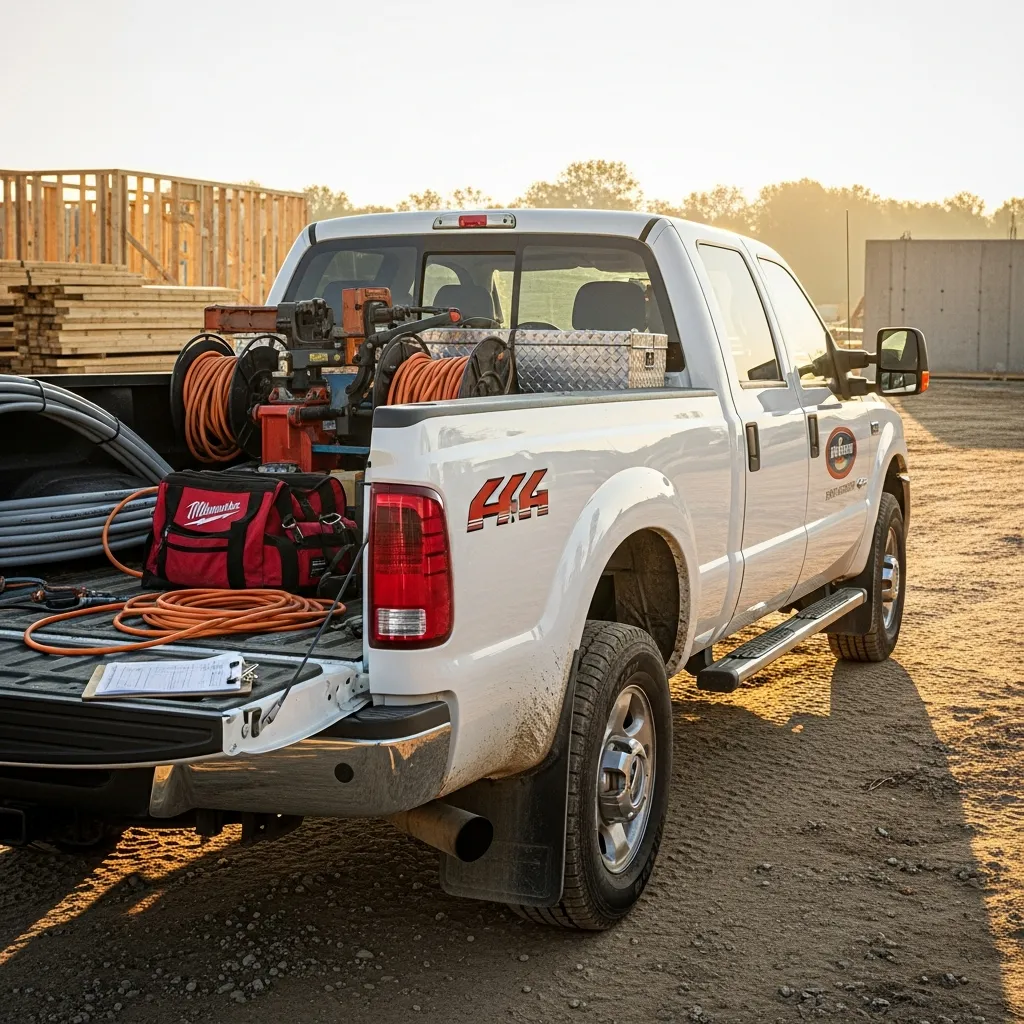
If your truck is clearly a work truck — a service body with racks, your company name on the side, no back seat, full of tools — the IRS is much less likely to question 100% business use. If it is a crew cab pickup that could double as a family vehicle, you need that mileage log. A contractor we work with got audited three years ago and lost a $40,000 deduction because he had no mileage log and the IRS assumed 50% personal use. He ended up owing $12,000 in back taxes plus penalties. Do not let that be you.
For more on how to document expenses properly and avoid these kinds of surprises, check out the guide on construction tax deductions.
Can I Deduct My Personal Truck If I Use It for Work Sometimes?
Yes, but only the business-use percentage. If you drive your personal F-150 to job sites twice a week and use it for personal errands the rest of the time, you need to track the split. Let us say you drive 20,000 miles a year and 6,000 of those are business trips. You can deduct 30% of your vehicle expenses — insurance, fuel, maintenance, depreciation, or loan interest. For 2026, the standard mileage rate is 70 cents per mile (this rate adjusts annually). So you could deduct $4,200 (6,000 miles × $0.70) instead of tracking actual expenses.
Most contractors find the standard mileage rate easier. You do not need receipts for gas or oil changes — just a mileage log. But if your truck is expensive and you put a lot of business miles on it, actual expenses might give you a bigger deduction. You can switch between methods, but once you use actual expenses on a vehicle, you cannot switch back to standard mileage. Talk to your accountant before you pick a method.
What If I Own Multiple Vehicles?
You can deduct all of them, as long as each one is used for business and you keep separate logs. A lot of contractors have a truck for themselves, another for a foreman, maybe a van for the apprentice. Each vehicle gets its own deduction based on its business use percentage. The Section 179 limit of $1,220,000 applies across all vehicles combined, but unless you are buying a whole fleet, you will not hit that cap.
Here is a real scenario: You are a remodeling contractor and you buy a $70,000 truck for yourself and a $40,000 van for your lead carpenter. Both are over 6,000 pounds GVWR and used 100% for business. You take a $110,000 Section 179 deduction in year one. If your taxable income is $200,000, that drops it to $90,000, saving you about $33,000 in taxes. That is basically a free van.
If you are managing multiple vehicles and trying to track costs per job, you also need a system that ties vehicle expenses back to job costs — not just for taxes, but so you know what it actually costs to run each crew. This is where job costing becomes critical.
What Happens If I Get Audited?
If the IRS audits your vehicle deduction, they will ask for your mileage log first. If you do not have one and you claimed more than 50% business use, they will disallow part or all of the deduction. You will owe back taxes on the disallowed amount, plus interest and possibly a 20% accuracy penalty. On a $60,000 deduction, that could mean you owe $18,000 in taxes plus another $3,600 in penalties. It is brutal.
The good news is that if you have a mileage log, receipts, and a reasonable business-use percentage, most audits end quickly. The IRS is looking for contractors who clearly used a truck personally and wrote off 100% of it with no records. If you can show that you tracked your use and only deducted the business portion, you are fine.
One more thing: If you are using your truck to haul tools and materials between jobs, take photos of the truck loaded up and keep them in a file. If you get audited, those photos are gold. They show that the truck is not just a commuter vehicle — it is a piece of equipment.
Should I Buy the Truck in My Business Name or Personal Name?
If you are an LLC or S-corp, buy it in the business name. This keeps liability separate and makes the deduction cleaner. If you are a sole proprietor, it does not matter as much — you can buy it personally and still deduct business use on Schedule C. But if you ever get sued and the truck is titled personally, it could be at risk. Buying in the business name protects it.
One thing to watch: If you are an S-corp and you use a company truck for personal use, that personal use is considered taxable income to you. Your accountant should add it to your W-2 as a fringe benefit. Most contractors do not know this, and it is a common audit issue. If you want to avoid the hassle, keep one truck personal and one truck business, and never mix them.
Bottom Line: How to Actually Do This on Monday Morning
Here is your action plan if you bought a truck recently or you are planning to buy one in 2026:
- Check the GVWR sticker on the driver's side door. If it is over 6,000 lbs, you can use Section 179 with no caps. If it is under, you are limited to about $20,000 in year one.
- Start a mileage log today. Use an app or a simple spreadsheet. Track every business trip for 90 days to establish your percentage.
- Talk to your accountant before you buy. If you are on the fence between two trucks and one is 5,800 lbs and the other is 6,500 lbs, the heavier one will save you thousands in taxes.
- Make sure the truck is titled in your business name if you are an LLC or S-corp.
- Take photos of the truck in use on job sites and keep them in a file labeled 'Vehicle Records.'
- If you are financing, do not wait until the truck is paid off to take the deduction — you get the full Section 179 deduction in year one regardless of how you paid for it.
If you are juggling multiple trucks, crews, and jobs and you are not sure how to track all this without losing your mind, a proper financial system makes it automatic. We have helped hundreds of contractors set up workflows that capture mileage, tie vehicle costs to jobs, and keep audit-proof records without adding hours to your week. You can see how that works in our breakdown of construction financial systems.
The truck deduction is one of the biggest tax breaks available to contractors, but only if you do it right. Take 20 minutes this week to get your records in order, and you will save yourself thousands in taxes and a massive headache if the IRS ever comes knocking.
#ConstructionTax #ContractorTaxTips #Section179 #TruckDeduction #ContractorCFO #ConstructionBookkeeping


