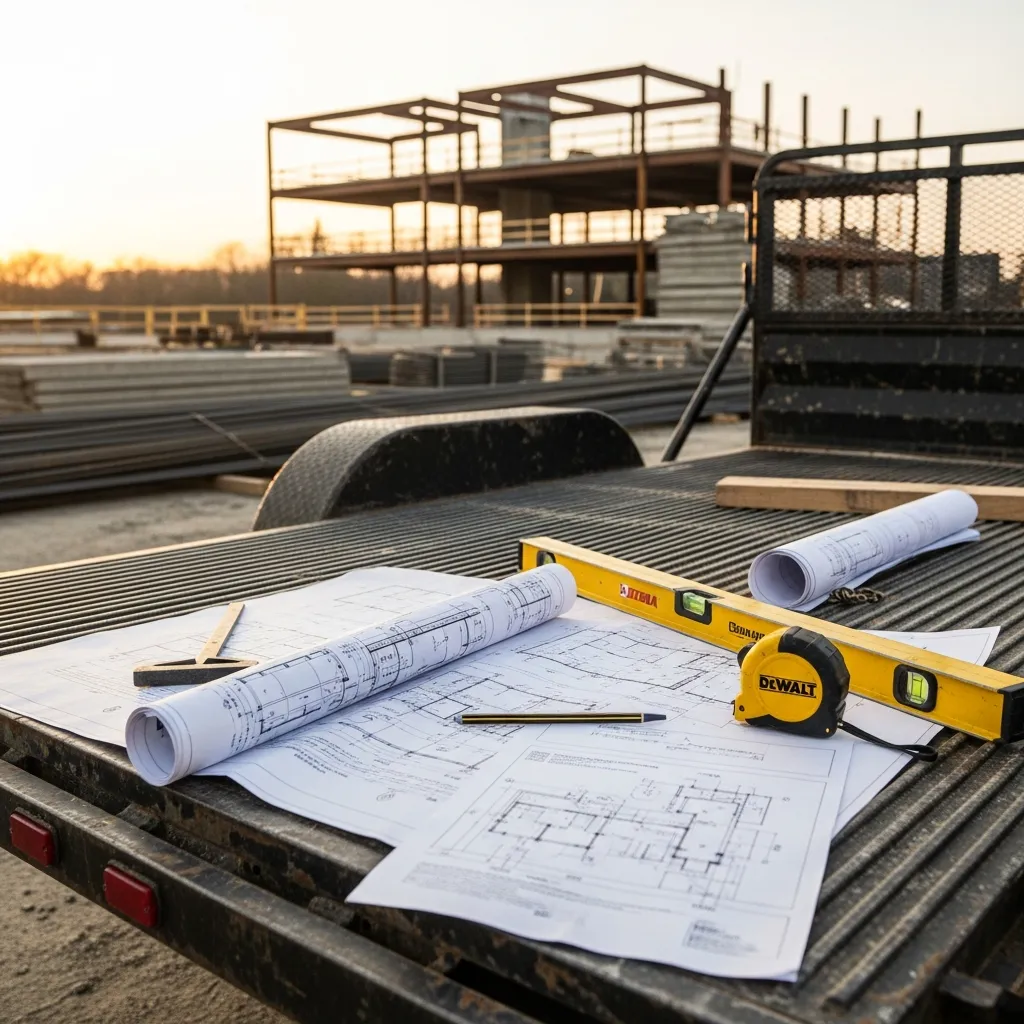
How Rising Interest Rates Impact Your Construction Jobs
Rising interest rates in 2026 directly affect your construction business in three ways: your customers have less buying power so fewer projects move forward, your equipment financing costs more each month, and floating a job on credit cards or lines of credit eats a bigger chunk of your margin before you even get paid.
If you are a remodeler, commercial GC, or specialty contractor, you have probably noticed something shifting in the last year. Clients are slower to pull the trigger. Banks are pickier about loans. And that line of credit you have been using to bridge cash flow gaps? The monthly interest just keeps climbing. This is not your imagination — interest rates have real, immediate effects on how construction companies make money, and most contractors are not adjusting their pricing or project selection fast enough to keep up.
Let me walk you through exactly what is happening, what it costs you in real dollars, and how to protect your margins without turning away good work.
Why Do Interest Rates Matter to Construction Companies?
Interest rates are not just something that affects your mortgage or car payment. They ripple through your business in ways that are easy to miss until your bank account is lighter than it should be.
First, your customers feel it. A homeowner who could afford a $120,000 kitchen remodel at 4% interest might only qualify for $95,000 at 7%. Commercial developers pencil out projects based on financing costs — when rates go up, some projects that looked profitable six months ago suddenly do not make sense anymore. Deals fall apart. Timelines stretch. You get more 'let me think about it' and fewer signed contracts.
Second, your own financing costs more. If you lease equipment, finance trucks, or carry a business line of credit, every percentage point increase hits your monthly overhead. A $50,000 equipment loan at 5% costs you about $943 a month over five years. That same loan at 8%? Now it is $1,013 a month. That is $840 a year more — and if you are running on 10% net margins, you need an extra $8,400 in revenue just to break even on that one loan.
Third, carrying costs kill you. Most contractors float jobs — you pay subs, buy materials, cover payroll, and wait 30 to 60 days (or longer) to get paid. If you are using a credit card or line of credit to cover that gap, rising rates mean you are paying more every month just to keep the lights on. A $40,000 balance on a business credit card at 18% APR costs you $600 a month in interest. At 22%? Now it is $733. That is $1,600 a year just evaporating.
Rates do not just make things a little tighter. They change which jobs are profitable and which ones quietly drain your account. If you have not looked at your job costing recently, now is the time.
How Much Is This Actually Costing You Per Job?
Let me make this real with an example. Say you are an HVAC contractor running a $75,000 commercial install. Your direct costs are $50,000 (equipment, labor, subs). You expect a $25,000 gross profit — that is a 33% margin, which sounds great on paper.
But here is what actually happens: You pay $30,000 up front for equipment and materials. You cover two weeks of payroll at $8,000. You pay a subcontractor $12,000 to rough in ductwork. You are $50,000 out of pocket before the client pays you a dime. The job takes 45 days from start to invoice, and the GC pays you 30 days after that. So you are carrying $50,000 for 75 days.
If you are floating that on a line of credit at 9%, here is the math: $50,000 × 9% ÷ 365 days × 75 days = $923 in interest. Your $25,000 profit just became $24,077. Your real margin is now 32%, not 33%.
Now imagine rates climb to 11%. Same job, same timeline. Now you are paying $1,130 in interest. Your profit drops to $23,870 — a 31.8% margin. You just lost another $207, and you did not change a single thing about how you ran the job.
Multiply that across 20 jobs a year, and rising rates just cost you $4,140 in profit you will never see. That is real money — enough to hire part-time help, buy a new tool trailer, or actually take a weekend off.
This is why cash flow management is not some boring accounting thing. It is the difference between a profitable year and wondering where all the money went.
What Should You Do Right Now?
Here is the good news: you do not have to just eat these costs. You can adjust how you price jobs, structure payment terms, and choose which projects to take. Here is a step-by-step framework you can use starting Monday.
Step 1: Add a Financing Cost Line to Every Estimate
Most contractors price jobs based on hard costs plus margin. But if you are floating $40,000 for 60 days, that has a cost — and it should be in your estimate. Calculate it like this:
Your out-of-pocket costs × your interest rate ÷ 365 × days until you get paid = financing cost
Let us say you are bidding a $120,000 remodel. Your costs are $85,000, and you will not get final payment for 90 days. Your line of credit is at 10%. Your financing cost is: $85,000 × 10% ÷ 365 × 90 = $2,096. Add that to your estimate as a line item or bake it into your margin. Either way, you need to know the number.
Step 2: Tighten Your Payment Terms
If you are still doing the standard 'deposit, progress payment, final payment' structure, you are leaving money on the table. In a higher-rate environment, you need cash coming in faster. Here is what to push for:
- Bigger deposits: Move from 10% to 25% or even 30% up front. This covers your initial material buys without touching your credit line.
- More frequent progress billing: Bill every two weeks instead of monthly. The faster you invoice, the faster you collect, the less you carry.
- Net 15 instead of Net 30: Every day you shorten your payment window saves you interest. On that $85,000 job, collecting 15 days earlier saves you about $350.
Yes, some clients will push back. But in 2026, everyone understands financing costs are real. Frame it as 'our terms have adjusted to reflect current market conditions' and most reasonable clients will get it.
Step 3: Get Pickier About Which Jobs You Take
Not all revenue is good revenue. A $200,000 job that takes four months, requires you to float $120,000, and pays you 60 days after completion might actually be worse for your business than two $80,000 jobs with tighter payment schedules.
Run this filter on every bid: How much cash do I need to carry, for how long, and what does that cost me? If the answer is 'a lot, for a long time, and I do not know,' that is a red flag. You might need to:
- Pass on jobs with long payment cycles unless you can negotiate better terms
- Prioritize clients who pay on time (or early)
- Avoid fixed-price contracts with slow-paying GCs unless you add a significant buffer
This is not about turning down work. It is about understanding which work actually makes you money after all the hidden costs.
Should You Pay Down Debt or Keep Cash on Hand?
This is the question every contractor is wrestling with right now. You have $30,000 in the bank. Do you pay down your line of credit, or do you keep it as a cushion?
Here is the rule of thumb: If your interest rate is above 10%, pay it down. If it is below 8%, keep the cash. If it is in between, it depends on how lumpy your cash flow is.
Why? Because cash gives you options. If you pay down your line to zero and then a client is 30 days late on a $50,000 invoice, you are back to borrowing again — except now you are stressed and scrambling. But if you are paying 14% on a credit card balance, every month you leave that balance sitting there is costing you over 1% of the total. That is expensive.
The smarter move: build a cash reserve equal to one month of operating expenses (payroll, rent, insurance, truck payments). Once you hit that number, throw every extra dollar at high-interest debt. Then, once your debt is under control, start building a bigger cushion — aim for two to three months of expenses. This is what a Fractional CFO would tell you to do, and it is exactly how the contractors who sleep well at night operate.
How Do You Know If a Rate Hike Just Killed Your Margins?
Most contractors do not realize a job went sideways until months later when they look at the bank account and think 'wait, where did it all go?' Here is how to catch it in real time.
Every month, pull three numbers:
- Your average days to collect: How long from invoice to payment? If this number is creeping up, you are carrying costs longer.
- Your total outstanding receivables: How much are clients currently owing you? If this is growing faster than your revenue, you are floating more jobs than before.
- Your interest expense: Look at your credit card and line of credit statements. What did you pay in interest last month? Compare it to the same month last year. If it is up 30% but your revenue is only up 10%, rates are eating your profit.
If you do not have these numbers handy, you are flying blind. And in a rising-rate environment, that is how contractors go from 'busy and profitable' to 'busy and broke' without seeing it coming.
One Last Thing: Do Not Panic, Just Adjust
Look, rising rates are not great. But they are also not a death sentence. The contractors who get hurt are the ones who keep running their business the same way they did in 2021 when money was cheap and clients were throwing cash around. The contractors who thrive are the ones who adjust.
You do not need to become a finance expert. You just need to know your numbers, tighten your payment terms, and price jobs based on the actual cost of doing business — not what it cost two years ago. Do that, and you will be fine. Better than fine, actually, because half your competitors are not paying attention to this stuff and they are going to keep bleeding margin until it is too late.
You started a construction company because you are good at building things. That has not changed. But the money side matters more now than it did before, and a little bit of focus here will keep more dollars in your account where they belong.
#ConstructionFinance #ContractorCashFlow #InterestRates #ConstructionBusinessTips #ContractorProfit #JobCosting


