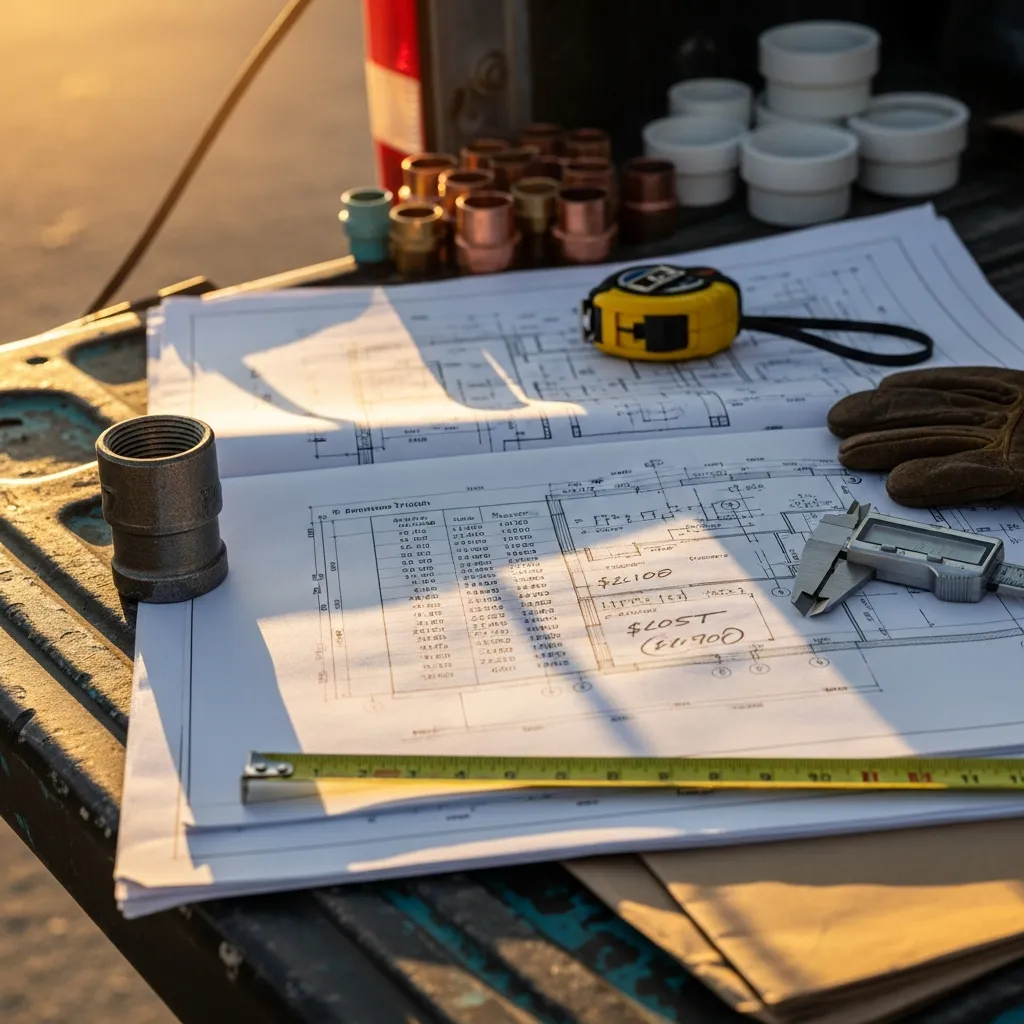
Tariff Impact on Construction Costs: 2026 Pricing Guide
If you are wondering how Trump-era tariffs in 2026 will affect your bids, here is the short answer: steel prices are up 18-25%, aluminum up 12-18%, and lumber could swing 10-15% depending on where it is sourced. If you are not building tariff contingencies into your quotes right now, you are bidding jobs at 2025 prices that you will execute at 2026 costs — and that gap will come straight out of your profit.
Let us talk about what this actually means for your business, how to protect your margin, and what you can do Monday morning to stop leaving money on the table.
What Are Tariffs and Why Should a Contractor Care Right Now?
A tariff is a tax the government slaps on imported goods. In 2026, we are seeing aggressive tariffs on steel, aluminum, certain lumber products, and a range of building materials coming from Canada, China, and the EU. This is not abstract trade policy — this is your invoice from the steel supplier jumping 20% between the time you bid a job and the time you frame it.
Here is a real-world example: You are a commercial contractor who bid a 12,000-square-foot warehouse addition in December 2025. You estimated structural steel at $48,000 based on supplier quotes. You lock in the contract. By March 2026, when you actually order the steel, the tariffs have kicked in and that same material package is now $57,600. You just lost $9,600 in profit because you did not build in price protection.
This is not about politics. This is about math. And if you are bidding fixed-price contracts without tariff clauses or material escalation language, you are gambling with your margin.
Which Materials Are Getting Hit the Hardest in 2026?
Not every material is affected equally. Here is where the pain is concentrated as of early 2026:
- Structural Steel: Up 18-25% on imported beams, columns, and rebar. Domestic steel is also climbing because suppliers know they can.
- Aluminum: Tariffs on Canadian and Chinese aluminum have pushed prices up 12-18%. If you are doing metal roofing, curtain walls, or HVAC ductwork, this hits you.
- Lumber: Canadian softwood tariffs are back in play. Framing lumber is volatile but expect 10-15% swings. Engineered wood products like LVL and glulam beams are also affected.
- Electrical Components: Anything with steel enclosures, aluminum conduit, or Chinese-manufactured panels is up 8-15%.
- Roofing Materials: Metal roofing panels, flashing, and fasteners are seeing 10-20% increases depending on the source.
- Drywall and Insulation: Less direct impact, but gypsum board costs are creeping up 3-6% due to fuel and transport cost pass-throughs.
If you are a framing crew running three jobs at $180K each, and 35% of your costs are lumber and fasteners, a 12% material spike could eat $7,560 per job if you are not protected. That is $22,680 across three jobs — probably more than your net profit for the quarter.
What About Domestic Materials? Are They Safe?
Not really. Domestic suppliers know the tariffs reduce competition, so they raise prices too. It is not a 1:1 match with the tariff rate, but you will see 60-80% of the tariff cost passed through even on USA-made steel and aluminum. The market does not stay cheap just because one option got more expensive.
How Do I Protect My Margin When I Am Bidding Jobs Right Now?
You have three tools: material escalation clauses, tariff pass-through language, and shorter bid validity windows. Let us break each one down.
1. Material Escalation Clauses
This is a contract term that says if material costs go up more than X% between bid and purchase, the owner pays the difference. Here is simple language you can adapt:
'Material prices are based on quotes valid as of [date]. If structural steel, aluminum, or lumber costs increase more than 5% between contract signing and material purchase, the contract price will be adjusted to reflect actual costs with documentation provided.'
Most sophisticated owners and GCs expect this in 2026. If they push back, you can offer to share the risk — say, you eat the first 3%, they pay anything above that. The key is you are not absorbing a 20% swing solo.
2. Tariff Pass-Through Language
This is more specific and pins the risk to government policy, not just market fluctuations. Example:
'This bid does not include costs associated with tariffs imposed after [date]. Any tariff-related cost increases on steel, aluminum, lumber, or imported materials will be billed as a change order with supplier documentation.'
This makes it crystal clear: if the government changes the rules mid-job, the owner is on the hook, not you. Some owners will not sign this. That is fine — now you know you need to pad your bid by 10-15% to cover the risk, and you can price accordingly.
3. Shorter Bid Validity Windows
Instead of quoting jobs good for 90 days, cut it to 30 or 45. Add this line to your proposals:
'This quote is valid for 30 days. Material costs are fluctuating due to tariff policy and we cannot guarantee pricing beyond this window without updated supplier quotes.'
Yes, this adds friction. But it is better than honoring a stale bid that loses you $15K because the owner sat on it for two months while steel prices climbed.
What Should I Do If I Already Signed a Fixed-Price Contract?
First, pull the contract and read it. Look for any language about unforeseen conditions, material cost changes, or force majeure. Some contracts have clauses that allow renegotiation if conditions change dramatically. It is a long shot, but worth ten minutes to check.
Second, document everything. If you are ordering materials now and the invoices are significantly higher than what you bid, save those quotes. Take screenshots of price changes from suppliers. If you need to have a conversation with the owner or GC about cost overruns, you need proof that this is not you padding the budget — this is real market movement.
Third, have the conversation early. Do not wait until you are halfway through the job and bleeding cash. If you are facing a $12K overage on materials, call the owner now and say, 'Here is what we are seeing. Here is the documentation. We are not asking you to cover all of it, but we need to talk about how we handle this so the job does not stall.' Most reasonable owners would rather negotiate than deal with a contractor who runs out of money mid-project.
If the contract is ironclad and the owner will not budge, your options are limited. You can eat the cost and learn an expensive lesson about contract language, or you can look for cost savings elsewhere — cheaper subs, value engineering, tighter labor management. Neither is fun, but it is reality. This is also a good time to talk to someone who understands job costing for construction so you can see exactly where the bleeding is happening and whether the job is salvageable.
How Do I Explain Tariff Costs to Clients Without Sounding Like I Am Making Excuses?
Clients do not follow trade policy. They just see a number that is higher than they expected. Your job is to connect the dots for them without sounding defensive.
Here is a script that works:
'Material costs have increased significantly in the last few months due to tariffs on imported steel and aluminum. For example, the structural steel for your project was quoted at $X in December. As of today, that same package is $Y — an increase of Z%. This is not a markup on our end. Here is the supplier invoice showing the new pricing. We want to be transparent about this so there are no surprises.'
You are not apologizing. You are not asking permission. You are stating facts and backing them up with documentation. Most clients respect that, especially if you are the first person on the project who bothered to explain what is happening instead of just jacking up the bid with no context.
If you are dealing with a GC and you are the sub, the same logic applies. Send an email with the subject line 'Material Cost Update — Tariff Impact on [Trade/Scope]' and attach the supplier documentation. Make it easy for them to pass the info up the chain. The faster everyone understands this is an industry-wide issue, the less it feels like you are the problem.
What If I Am in the Middle of Estimating Right Now? How Do I Price This?
Call your suppliers today and ask for current pricing and how long it is good for. Do not use pricing from 60 days ago. Do not assume the quote you got in January is still valid in March. If the supplier will not lock in pricing for more than two weeks, that tells you something about the volatility — and you need to price accordingly.
Here is a simple framework for tariff-risk pricing:
- Low-risk scenario: You have a signed supplier quote good for 60+ days, domestic materials, or a small material component of the job. Add 2-3% contingency.
- Medium-risk scenario: You are 30-45 days from material purchase, significant steel or aluminum in the scope, or supplier quotes are only good for 30 days. Add 8-10% contingency on affected materials.
- High-risk scenario: You are 60+ days from purchase, tariffs are actively changing, or the owner will not agree to escalation language. Add 15-20% contingency on affected materials or walk away from the job.
Let us say you are bidding a commercial roof replacement. Total material cost is $85,000, of which $60,000 is metal roofing panels and flashing (tariff-exposed). If you are in a medium-risk scenario, add 10% to that $60,000 — so $6,000 — to your bid. Yes, this might make you less competitive. But winning a job that loses money is not winning.
This is also where having a solid handle on your numbers matters. If you do not know your true construction cash flow or how much margin you actually need to keep the lights on, you are guessing. And guessing in a tariff environment is expensive.
Is There Any Way to Reduce My Exposure to Tariff Price Swings?
Yes. Here are a few tactical moves:
- Buy materials earlier: If you have a signed contract and the cash flow to do it, order long-lead items now and store them. You lock in today's price and remove the risk. This only works if you have the cash and the space, but it is a real hedge.
- Negotiate supplier relationships: If you are a repeat customer, ask your supplier if they will honor a price for 60 or 90 days if you commit to volume. Some will, especially if they want to keep your business.
- Switch to domestic suppliers where possible: Domestic materials are not immune, but they are less volatile. If you can source USA-made steel or aluminum without a huge cost jump, it reduces your tariff exposure.
- Use alternative materials: If you are spec'd for metal roofing and the price is crazy, can you propose a high-quality synthetic or asphalt option? If you are using aluminum flashing, can you switch to coated steel? This requires owner approval, but it is worth the conversation.
- Build buffer into your schedule: If you can delay material purchases until pricing stabilizes or until you have better clarity on tariff policy, that is a form of risk management. Obviously this does not work if the owner has a hard deadline, but if you have flexibility, use it.
None of these are magic bullets, but each one reduces your exposure by a few percentage points. Stack them together and you can take a 20% risk down to a 7-8% risk, which is a lot easier to price for.
What Should I Be Tracking in My Books to Catch This Stuff Early?
If you are not tracking job costs in real time, you will not see the tariff bleed until it is too late. Here is what you need to be watching:
- Actual vs. estimated material costs by job: Every time you get an invoice, compare it to what you estimated in the bid. If you are seeing consistent overruns of 10-15%, that is your signal that your estimating assumptions are stale.
- Material cost as a percentage of total job cost: If this number is creeping up across multiple jobs, tariffs are eating you. For most trades, material cost should be 30-50% of total job cost. If it is suddenly 55-60%, you have a pricing problem.
- Gross profit margin by job: This is revenue minus direct costs (labor, materials, subs, equipment). If your gross margin is shrinking job over job, and labor and sub costs are stable, materials are the culprit.
- Unpaid change orders: If you are submitting change orders for tariff-related overruns and they are not getting approved, that is cash you are owed that is not hitting your account. Track it separately so you know how much you are carrying.
If you do not have a system that tracks this stuff, you are flying blind. A good fractional CFO can set this up for you in a week and show you exactly where the leaks are. But even if you are doing it yourself in a spreadsheet, just start tracking actual vs. estimated material costs per job. That one number will tell you more than almost anything else.
Bottom Line: What Should I Do Monday Morning?
Here is your action list:
- Call your top three suppliers. Ask for current pricing on your most-used materials and how long the quote is valid. Write it down.
- Review any open bids or proposals. If you quoted a job more than 30 days ago and have not signed a contract, update your material costs before you do.
- Add escalation language to your contract template. Use one of the examples above or have your lawyer tighten it up. Make it standard on every job going forward.
- Pull your last three completed jobs. Compare estimated material costs to actual invoices. If you are seeing a pattern of overruns, that is your margin leak.
- Have a conversation with your GC or owner on active jobs. If you are about to order materials and the price has jumped, do not wait. Document it and communicate it now.
This is not a fun time to be bidding work, but it is also not the first time material prices have gone sideways. The contractors who survive this are the ones who price for reality, protect their margin in the contract, and track their costs tight enough to catch problems early. You have built harder things than a pricing model. You can handle this.
#ConstructionCosts #TariffImpact #ContractorTips #ConstructionBidding #JobCosting #ConstructionFinance


