What Do Trump's 2025 Tariffs Mean for Contractor Costs?
Trump's proposed 2025 tariffs will likely increase material costs for contractors by 10-30% on steel, aluminum, lumber, and imported tools. For a commercial contractor running $3M annually, that could mean $90K-$150K in additional material expenses in 2026 if you don't adjust your bidding and purchasing strategy now. The good news? You have time to protect your margins if you act before these hit your suppliers' price sheets.
Why Should Contractors Care About Tariffs Right Now?
Because the jobs you're bidding this month might not start until Q2 or Q3 2026, and the materials you'll buy then could cost 15-25% more than today's quotes. If you locked in a fixed-price contract based on January 2026 pricing and you're buying materials in June 2026 after tariffs kick in, you just ate that entire increase. On a $250K commercial build-out with $80K in materials, a 20% tariff-driven increase means $16K straight out of your profit. If you were planning on a 12% net margin ($30K), you just lost more than half of it.
Here's what's actually on the table based on the proposed tariff structure: 10-25% on steel and aluminum products (think structural steel, HVAC components, electrical conduit, roofing materials), 15-20% on lumber and engineered wood from Canada, and 10-15% on tools and equipment manufactured overseas. Even domestic suppliers will raise prices because the competition just got more expensive. Your local lumber yard isn't going to keep prices low out of charity when their costs are climbing.
The contractors getting hurt worst are the ones who bid jobs 90-180 days out, lock in a price, then buy materials as needed. You know who you are. You're the mechanical contractor who gave a fixed bid in February for a job starting in July, planning to order the HVAC units and copper pipe when the job kicks off. If tariffs hit in April and your supplier jacks up prices 18%, you're now buying $45K of equipment that you budgeted at $38K. That $7K difference? That's your truck payment and your kid's braces.
Which Materials Will Actually Cost More in 2026?
Let's get specific because 'materials will cost more' doesn't help you on Monday morning. Here's what you should be watching based on the tariff proposals and where your materials actually come from:
Steel and aluminum: Structural steel, rebar, metal framing, ductwork, conduit, roofing panels, and fasteners. If it's metal and it goes into a building, expect 10-25% increases. A framing crew that uses $12K of steel studs and track on a typical commercial tenant improvement could see that jump to $14K-$15K. Doesn't sound like much until you're running six of those jobs simultaneously.
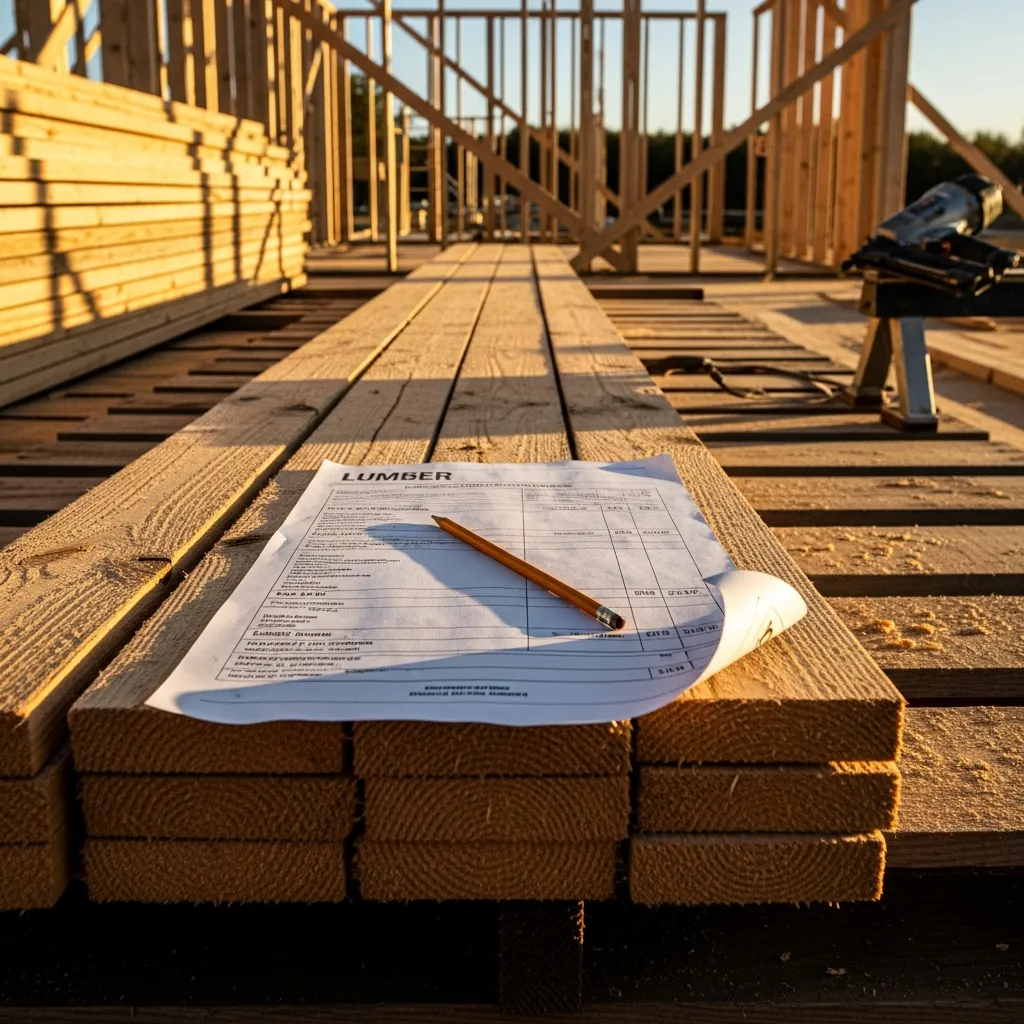
Lumber and engineered wood: Dimensional lumber, plywood, OSB, LVL beams, I-joists. Canada supplies about 30% of US lumber, and they're a primary tariff target. A custom home builder framing a $400K house with $55K in lumber and engineered wood could face an additional $8K-$11K. That's real money, especially when you're already dealing with tight margins on fixed-bid residential work.
Electrical components: Wire, panels, breakers, fixtures, conduit. Much of this is manufactured overseas or uses imported copper and aluminum. An electrical contractor wiring a 12-unit multifamily project with $38K in materials budgeted could see costs hit $43K-$45K.
HVAC equipment: Condensers, air handlers, ductwork, refrigerant lines. Even units assembled domestically often use imported components. A mechanical contractor installing seven rooftop units at $4,800 each ($33,600 total) might face a new reality of $5,500-$5,750 per unit ($38,500-$40,250 total).
Tools and equipment: Power tools, safety equipment, scaffolding, laser levels, compressors. Most are manufactured overseas. This hits your overhead, not individual jobs, but it still comes out of the same pot. Planning to replace that beat-up skid steer you've been nursing along? A $45K machine could become a $50K-$52K decision.
How Do I Protect My Profit Margins Before Tariffs Hit?
This is the section you'll actually use. Bookmark it. Here's your framework for the next 90-120 days while you still have some control:
Step 1: Add tariff escalation clauses to every proposal over $75K. Stop writing fixed-price bids that lock you in for six months. Add language like: 'Material pricing based on costs as of [date]. Increases exceeding 8% due to tariffs, trade policy changes, or supply disruptions will be billed as a change order with documentation.' Will some clients push back? Yes. Will losing 15% of your profit because you didn't ask hurt more? Also yes. On commercial work and projects with sophisticated owners, this is standard. They're reading the same news you are.
Step 2: Prepay for materials on jobs starting in Q2-Q3 2026. If you've got a $180K project kicking off in May and you know you'll need $50K in steel, place that order now and eat the storage cost or ask your supplier to hold it. Most suppliers will warehouse materials for 60-90 days for good customers, especially if you're prepaying. Even if you're financing it on a credit line at 9% interest, that's cheaper than a 20% price spike. Run the math: $50K at 9% annual interest for 90 days = $1,125 in carrying cost. A 20% tariff on that same $50K = $10K. You just saved $8,875.
Step 3: Build 12-15% material buffers into new bids. Your standard material markup might be 10-12% to cover waste, delivery, and small price fluctuations. For jobs starting after April 2026, bump that to 22-25% total. If your actual costs only go up 10%, congratulations, you just had a more profitable job. If they go up 20%, you're covered. This isn't price gouging, this is risk management. You can always give money back or apply it as a credit. You cannot go back in time and rebid a job you already won at a loss.
Step 4: Renegotiate supplier agreements now. Call your top three suppliers this week and ask them point-blank: 'What's your plan when tariffs hit? Will you honor quotes for 30 days, 60 days, or until the PO is placed?' Get it in writing. Some suppliers will lock pricing for good customers if you commit to volume. Others will screw you the day the tariffs are announced. Better to know now than when you're trying to order trusses for a job that starts in three weeks.
Step 5: Track material costs by job, not by month. You need job costing set up so you can see exactly what percentage of your costs are materials and which materials are moving. If you don't know that steel studs are 18% of your total project cost on commercial tenant improvements, you can't model what a 20% price increase actually means to your bottom line. This isn't optional anymore. If you're still tracking costs in your head or on sticky notes, you're flying blind into a price storm.
What If I've Already Signed Fixed-Price Contracts for 2026 Work?
You're not alone, and you're not completely screwed, but you need to act fast. Here's the triage:
Option 1: Renegotiate now before tariffs are official. Call the GC or owner and have an honest conversation. 'We signed this agreement based on January pricing. Tariffs are likely coming that will increase our material costs by $X. Can we add an escalation clause or adjust the contract price now?' Most reasonable clients would rather have the conversation now than deal with you going broke or walking off the job halfway through. If you've got a good relationship and you come with actual numbers, many will work with you.
Option 2: Value engineer the scope to reduce material costs. Can you swap materials for domestic alternatives that won't be hit as hard? Can you redesign details to use less steel or aluminum? Can you switch from imported fixtures to domestic ones? A commercial contractor facing a $14K tariff hit on steel might be able to cut $9K by switching to a different framing system or reducing overengineering that the architect won't even notice.
Option 3: Eat it this time, but learn the lesson. If you're stuck and the client won't budge and you can't value engineer your way out, you might have to take the hit. But track every single dollar it costs you and use that data to never make this mistake again. This is expensive education. A remodeler who loses $8K on a kitchen project because of tariff-related cost overruns should tattoo 'escalation clause' on their forearm before bidding the next one.
And look, if you've got multiple contracts in this situation and the tariff impact is going to be $40K-$60K that you weren't planning for, that's a cash flow crisis, not just a margin problem. You might need to talk to your bank about a short-term increase to your line of credit or restructure some payments. This isn't something you can just 'work harder' your way out of.
How Do I Actually Calculate the Tariff Impact on My Jobs?
Here's the simple formula you can use right now with the estimates you've already sent out:
Step 1: Pull up your estimate and separate materials into categories: steel/aluminum, lumber, electrical, HVAC, other.
Step 2: Apply the likely tariff percentages: 20% to steel/aluminum, 15% to lumber, 12% to electrical and HVAC, 5% to other (because even domestic stuff will creep up).
Step 3: Add those increases together to get your total tariff-driven cost increase.
Step 4: Compare that number to your expected profit. If your tariff exposure is bigger than your profit margin, you have a problem.
Real example: You're an HVAC contractor bidding a light commercial job. Total bid: $145K. Your breakdown: $52K labor, $71K equipment and materials, $22K profit (15% margin). Of that $71K, about $58K is tariff-exposed (condensers, copper line sets, ductwork, electrical controls). Apply an average 15% tariff hit: $58K x 0.15 = $8,700 in additional costs. Your $22K profit just became $13,300. Your 15% margin just became 9%. Still profitable, barely, but that doesn't cover your overhead, your truck, your insurance, or the fact that you're spending 60 hours a week running this business.
Now run that same math on every proposal you've sent for work starting after March 2026 that doesn't have an escalation clause. Yeah. That's the number you need to fix.
Should I Stockpile Materials Now or Wait?
Depends on your cash position, your storage capacity, and how predictable your work is. Here's the decision tree:
Stockpile now if: You have steady, recurring work where you know what you'll use (like a mechanical contractor who installs the same HVAC systems every month), you've got the cash or credit to pay for it without starving other parts of the business, and you've got somewhere to store it that isn't going to result in theft or weather damage. Buying three months of copper pipe at today's prices when you know you'll use it anyway is a smart hedge.
Wait if: Your work is unpredictable and you might end up sitting on $40K of materials you can't use for nine months, you're already tight on cash and prepaying for materials means you can't make payroll or pay subs on time, or you don't have secure storage and you're going to lose 15% to theft and damage anyway.
The middle path: Identify the materials that are highest-cost and highest-risk for tariff impact, and stockpile those selectively. A framing contractor might prepay for steel studs and track but wait on lumber because it's less exposed. An electrical contractor might stock up on wire and panels but hold off on fixtures that aren't as tariff-sensitive.
What Else Should I Be Doing Right Now?
Three things that have nothing to do with tariffs but will make your business more resilient no matter what happens with trade policy:
First, get your job costing dialed in so you actually know your margins. If you don't know whether you made 8% or 18% on the last job, you can't model tariff impacts or make smart decisions about where to cut costs. You're just guessing. We see this constantly: contractors who think they're profitable because the bank account has money in it, but they haven't paid their subs yet or they're floating costs on a credit card they'll deal with 'later.' Real job costing systems don't lie. They'll tell you exactly where money is leaking and which jobs or which phases of jobs are actually making you money.
Second, build a 60-day cash reserve if you don't have one. Whether it's tariffs, a slow payment from a GC, an unexpected equipment breakdown, or just a gap between jobs, having two months of operating expenses in the bank is the difference between a problem and a crisis. For most contractors doing $1M-$3M annually, that's $80K-$150K sitting in a business savings account earning 4-5% interest that you never touch unless it's a genuine emergency. It feels impossible until you do it, and then it's the best decision you ever made.
Third, raise your prices now even if tariffs don't happen. Most contractors are undercharging because they're scared of losing work to the guy who bids cheaper. But if tariffs hit and everyone's costs go up 15%, prices across the industry will rise. If you raise your prices 10% now, you're just early. You'll lose some price-sensitive clients and win more clients who value quality and reliability. The contractors who succeed long-term aren't the cheapest, they're the ones who charge enough to deliver consistent quality and stay in business.
Look, nobody can predict exactly what's going to happen with tariffs or when or how much. But you can control how you bid, how you buy, and whether you're tracking your numbers well enough to see problems before they kill you. The contractors who win in 2026 won't be the ones who got lucky with pricing. They'll be the ones who built systems that let them adapt fast when costs change. That's not inspiration-poster nonsense, that's just how this works.
#ConstructionTariffs #ContractorProfit #ConstructionCosts #JobCosting #ConstructionBusiness #ContractorTips


