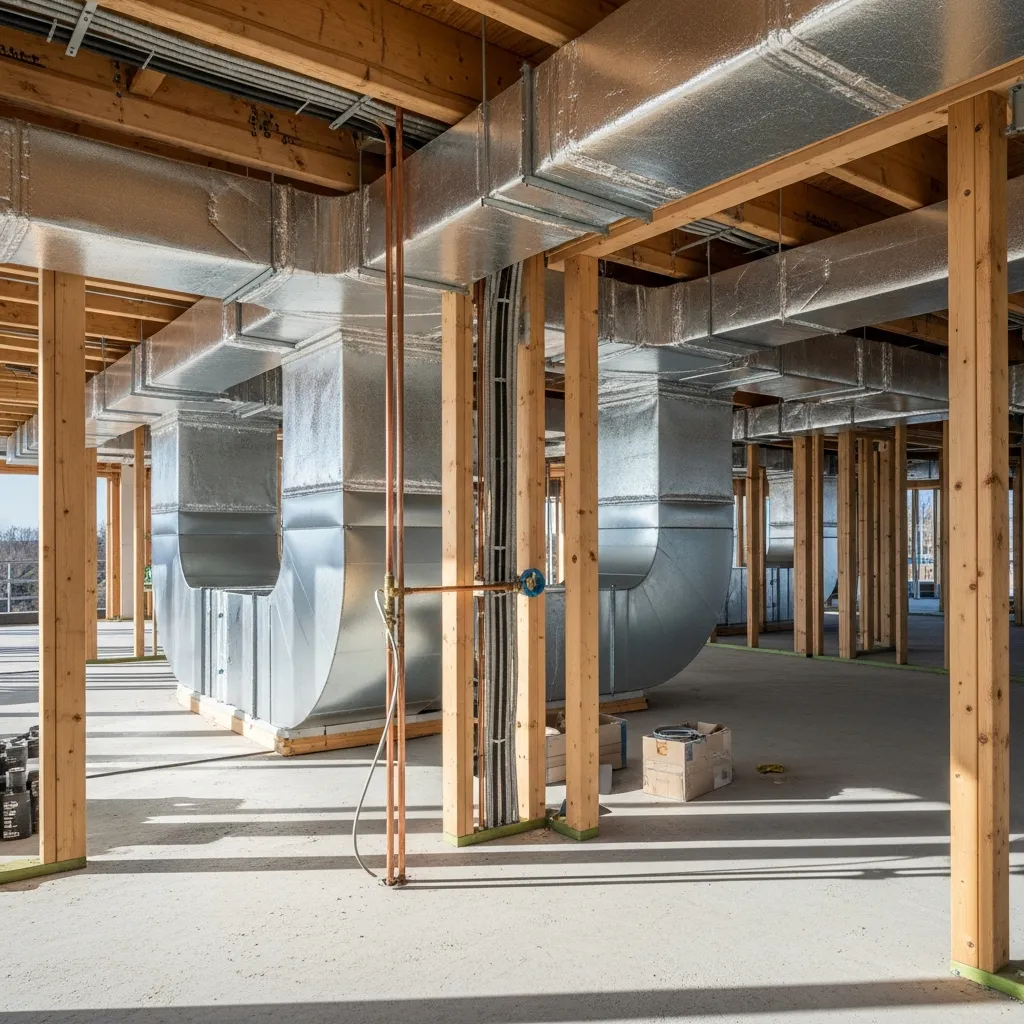
What HVAC Contractors Must Know About Financial Systems in 2026
If you run an HVAC business in 2026, you already know the technical side cold—refrigerant circuits, ductwork calculations, load estimates. But here is the hard truth: most HVAC contractors are losing money on jobs they think are profitable, and they do not discover it until tax season when their accountant delivers the bad news. The solution is not working harder or bidding higher—it is installing a financial system that connects your field operations to your books in real time, giving you clarity on every job, every technician, and every dollar.
Why Do HVAC Contractors Struggle With Their Numbers?
HVAC work is deceptively complex from a financial standpoint. You are juggling service calls, maintenance contracts, new installs, warranty work, emergency after-hours jobs, and material costs that fluctuate wildly. Refrigerant prices alone can swing 30% in a quarter. Copper costs? Do not get us started. Then add the reality that your techs are managing inventory from their trucks, submitting timecards on crumpled paper, and your office is drowning in supplier invoices from three different vendors.
The result? You have no idea which jobs made money until weeks after completion—if ever. Your QuickBooks file is a mess of uncategorized expenses. You cannot tell if that $47,000 commercial rooftop replacement actually cleared 20% or lost money once you factor in callbacks, overtime, and the compressor you had to overnight ship.
The Hidden Costs HVAC Contractors Miss
Most HVAC businesses track revenue just fine. It is the cost side that bleeds them dry. Here are the usual suspects:
- Unbilled service time: Your lead tech spent four hours diagnosing an intermittent fault but only billed for two because the customer pushed back.
- Truck stock shrinkage: That $1,200 in filters, contactors, and capacitors sitting in your service vehicles? Half of it walks off job sites or gets used without being invoiced.
- Warranty and callback labor: You eat the labor cost on a callback, but it never gets coded to the original job, so your gross profit looks better than reality.
- Permit and inspection fees: These get paid out of pocket and forgotten in job costing, quietly shaving 2-3 points off your margin.
- Untracked subcontractor costs: You hire an electrician for a panel upgrade on a new install, but the invoice sits in your inbox for three weeks and never hits the job.
Without a financial system that captures these costs in real time and ties them to specific jobs, you are flying blind. You might think you made $18,000 on that restaurant HVAC retrofit, but after callbacks, unbilled materials, and hidden labor, the real number was $6,400. That is not a profit problem—it is a visibility problem.
What Is a Financial System for HVAC Contractors?
A financial system is not software. It is a process—a set of connected workflows that ensure every dollar earned and spent is tracked, categorized, and tied to the right job in real time. For HVAC contractors, that means connecting three critical pieces:
- Your field management platform: Tools like ServiceTitan, Buildertrend, or Knowify where your techs clock in, log materials, and close out jobs.
- Your accounting backbone: QuickBooks Online, set up specifically for construction and service trades with proper job costing, class tracking, and chart of accounts.
- Your financial dashboard: A custom-built view that shows your top KPIs—gross profit by job type, labor burden, work-in-progress, cash position, and upcoming payables—updated weekly or daily.
When these three pieces talk to each other, you get clarity. You know within 48 hours whether a job made or lost money. You can see which types of work are most profitable (spoiler: it is usually not the emergency service calls you thought were gold mines). You can forecast cash flow 60 days out and make payroll decisions with confidence instead of hope.
This is what we build for HVAC contractors at Salisbury Bookkeeping. We call it our financial system, and it transforms how you run your business.
How Does Job Costing Actually Work for HVAC Companies?
Job costing is the foundation of financial clarity for any trades business, but it is especially critical for HVAC contractors because your cost structure is so variable. A residential furnace replacement has totally different margins than a commercial chiller install or a maintenance contract. If you lump them all together, you have no idea what is actually making you money.
Here is how proper job costing for construction works in practice:
- Every job gets a unique code: Not just 'Smith Residence' but 'Smith-2406-Furnace' so you can track labor, materials, subcontractors, and overhead for that specific scope.
- Timecards are coded to jobs: Your techs clock in and out using their phones, and every hour is assigned to the right job and phase (install vs. startup vs. callback).
- Materials are expensed to jobs: When your tech pulls a blower motor from truck stock, it gets logged and coded. When your supplier invoice arrives, it is matched to the job and phase.
- Overhead is allocated: A percentage of your rent, insurance, truck payments, and office salaries is allocated to each job based on labor hours or revenue, giving you true job profitability.
With this in place, you can run a report at month-end and see that residential installs averaged 38% gross margin, commercial service contracts hit 52%, but new commercial construction only cleared 14% after callbacks and change order delays. That is actionable intelligence. Now you know where to focus your sales efforts and which job types need better estimating or execution.
What About Change Orders and Time and Material Work?
HVAC contractors live in a world of scope creep. The ductwork is full of asbestos. The electrical panel is not up to code. The customer wants to add a zone. Every one of these changes needs to be captured as a formal change order, approved, and tracked separately in your job costing system. If it is not, you will finish the job thinking you made money on the base scope, not realizing you gave away $3,200 in extra labor and materials.
For time and material work—common in service and repair—your system needs to track every trip charge, every hour, and every part in real time. If your tech closes out the job in the field and your invoice is generated automatically from that data, you will never forget to bill for that $140 capacitor or the extra hour spent waiting for the supply house to open.
What KPIs Should HVAC Contractors Actually Track?
You cannot manage what you do not measure. But most HVAC contractors are either tracking nothing or drowning in 47 different metrics that do not matter. Here are the five KPIs that actually move the needle:
- Gross Profit Margin by Job Type: Not just overall margin—break it down by residential vs. commercial, service vs. install, new construction vs. retrofit. Target 35-50% depending on job type.
- Labor Burden Percentage: Total labor cost (wages, taxes, insurance, benefits) divided by revenue. HVAC contractors should aim for 25-35%. If you are over 40%, you are either underpricing or overstaffed.
- Work-in-Progress (WIP): The total value of jobs started but not yet billed. If your WIP is growing faster than your revenue, you have a billing problem or a project completion problem.
- Days Cash on Hand: How many days can you operate if all revenue stopped today? HVAC businesses should carry 30-45 days minimum to cover seasonal dips and equipment purchases.
- Accounts Receivable Aging: How much money is owed to you, and how old is it? If more than 20% of your AR is over 60 days, you have a collections problem that is choking your cash flow.
These five metrics should live on a single-page dashboard that updates every week. You should be able to glance at it Monday morning and know exactly where you stand. No digging through reports. No waiting for your bookkeeper to send a PDF. Just clarity.
This is the kind of financial visibility we create for HVAC contractors as part of our fractional CFO service. It is not about generating more reports—it is about giving you the one dashboard that tells you everything you need to know to make smart decisions.
How Do You Build This System Without Losing Your Mind?
Here is the good news: you do not have to build this yourself. You do not need to become a QuickBooks expert or spend 40 hours setting up integrations. You need a partner who has done this 100 times for HVAC contractors just like you.
The process looks like this:
- Week 1-2: Clean up your QuickBooks file. Set up proper job costing, class tracking, and chart of accounts tailored to HVAC operations.
- Week 3-4: Integrate your field management software (ServiceTitan, Buildertrend, etc.) so data flows automatically into QuickBooks. No more double entry. No more reconciling timecards by hand.
- Week 5-6: Build your custom financial dashboard with your top five KPIs, updated weekly or daily depending on your needs.
- Ongoing: Monthly reviews where we walk through your numbers, spot trends, and help you make decisions on pricing, hiring, equipment purchases, and cash flow.
This is not a software implementation. It is a partnership. We become your financial team—your bookkeeper, your controller, your CFO—for a fraction of the cost of hiring those roles in-house.
What Does This Actually Cost?
Most HVAC contractors spend between $1,500 and $4,000 per month for a full financial system and fractional CFO support, depending on revenue and complexity. Compare that to hiring a full-time bookkeeper at $50,000 per year plus benefits, who still will not give you strategic CFO-level guidance. The ROI is obvious. If we help you identify one unprofitable job type and stop bidding that work, we have paid for ourselves ten times over.
What Happens When You Finally Have Financial Clarity?
Imagine this: It is Monday morning. You pour your coffee, open your dashboard, and within 30 seconds you know exactly where you stand. You see that last week you billed $63,000, collected $48,000, and your WIP is healthy. Your gross margin last month was 42%, up three points from the prior month because you stopped doing that low-margin commercial service work. You have $87,000 in the bank and your next payroll is covered with room to spare. You know which jobs made money and which ones did not, and you have already adjusted your estimating template for next month.
That is not a fantasy. That is what life looks like when you have a financial system in place. The relief is profound. You sleep better. You stop worrying about whether you can make payroll. You stop feeling like you are working 70-hour weeks just to break even. You have control.
And when your banker asks for financials because you want to finance that new service truck? You send them a clean P&L, balance sheet, and WIP report in five minutes. When your spouse asks if you can afford that family vacation? You know the answer immediately. When a big commercial opportunity lands on your desk? You can model it out and decide if it is worth pursuing based on real data, not gut feel.
This is the outcome we are selling. Not bookkeeping services. Not software. Clarity. Relief. Control. Partnership. The confidence that comes from knowing your numbers inside and out.
The Bottom Line for HVAC Contractors in 2026
You did not start your HVAC business to become an accountant. You started it because you are great at solving complex mechanical problems and serving your customers. But if you do not have a financial system in place, you are gambling with your livelihood. You are hoping you are profitable instead of knowing it. You are reacting to cash crunches instead of preventing them.
The good news? This is fixable. It does not require a finance degree or a massive software investment. It requires a decision to stop tolerating financial chaos and to partner with someone who has built these systems dozens of times for contractors just like you.
We have got your back. Let us build you a financial system that gives you clarity, control, and the peace of mind that comes from knowing exactly where every dollar is.
#HVACContractors #ConstructionFinance #JobCosting #FinancialClarity #ContractorCFO #HVACBusiness


