
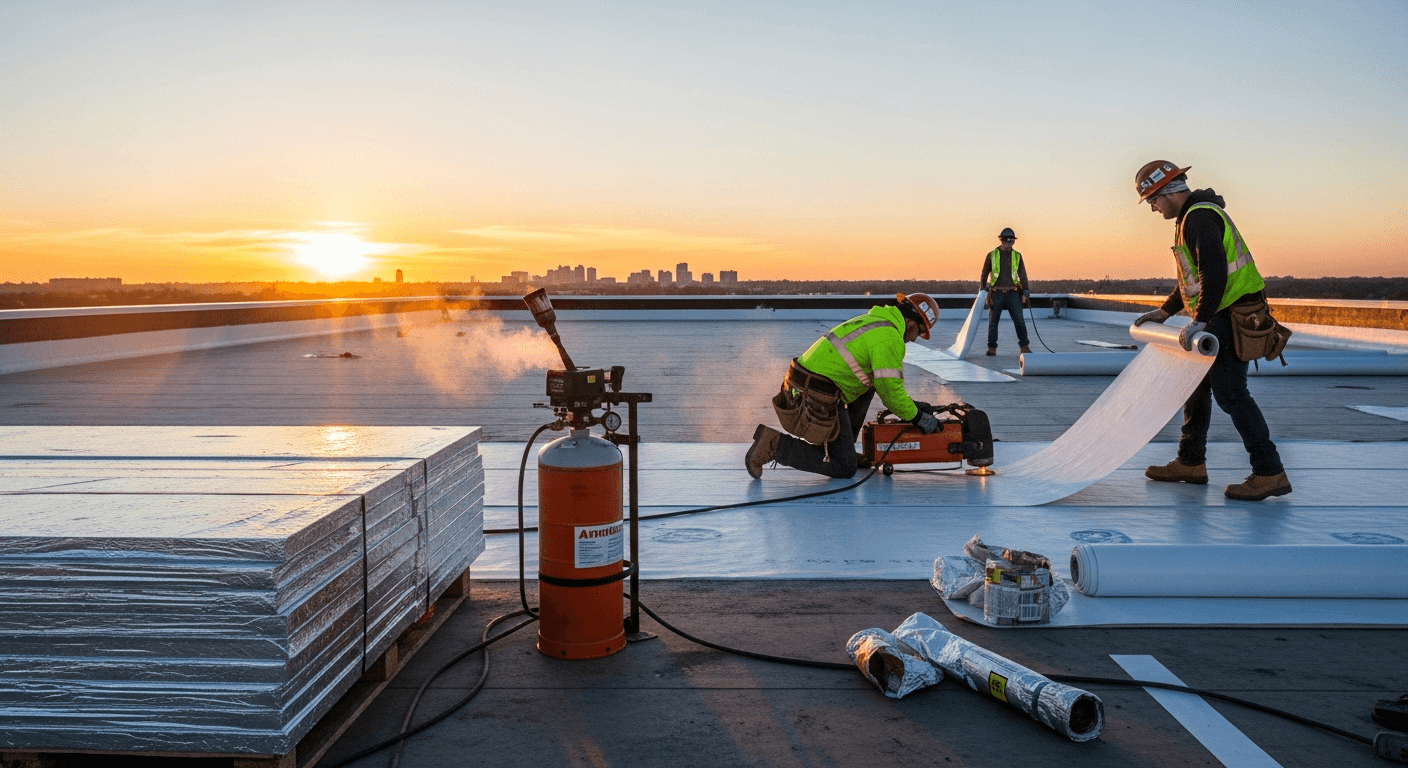

Most contractors treating a $150,000 roof replacement as a current-year repair expense face IRS penalties averaging $40,000 when audited. The difference between deductible repairs and capitalized improvements hinges on Treasury Decision 9636's three-step test that 73% of construction firms apply incorrectly.
Why roof work tax classification matters for contractors
The IRS treats roof work as either a currently deductible repair or a capital improvement that must be depreciated over 27.5 to 39 years. **Getting this wrong on a $200,000 commercial roof project costs you immediate cash flow and triggers audit risk.**
According to IRS Statistics of Income data for 2023, construction businesses claimed $14.3 billion in repair deductions. The agency challenges repair classifications in 42% of construction audits, with roof work representing the most common dispute category.
The IRS Section 1.263(a)-3 three-step test explained
Treasury Decision 9636, effective January 2014, created the Tangible Property Regulations that govern roof work classification. **Every roof project must pass through three sequential tests: betterment, restoration, and adaptation.**
Here's how the three-step analysis works:
- Betterment test — Does the work materially increase the building's value, substantially prolong its useful life, or adapt it to a new use?
- Restoration test — Does the work return the building to its ordinary operating condition after damage, decay, or obsolescence?
- Adaptation test — Does the work adapt the building or building system to a new or different use?
If any test indicates improvement, the entire cost must be capitalized. **Only work that fails all three tests qualifies as currently deductible repair.**
| Test Category | Repair Example | Improvement Example |
|---|---|---|
| Betterment | Replace damaged shingles with identical material | Upgrade from 20-year to 50-year membrane |
| Restoration | Patch leak in otherwise functional roof | Complete replacement of deteriorated roof system |
| Adaptation | Repair existing drainage system | Install new HVAC equipment requiring structural changes |
Safe Harbor provisions that protect smaller roof repairs
The IRS created automatic repair treatment for qualifying small costs under Revenue Procedure 2015-56. **The Safe Harbor de minimis rule allows immediate deduction of roof work costing $10,000 or less per building per tax year.**
Safe Harbor requirements include:
- Total cost per building cannot exceed $10,000 in any tax year
- Work must be performed on a building you own (not customer property)
- You must not capitalize the cost in your books and records
- The building's unadjusted basis must exceed $1 million
For amounts exceeding $10,000, you must still apply the three-step test. **The Safe Harbor creates a bright line but doesn't override the fundamental repair vs improvement analysis for larger projects.**
What roof repairs are tax deductible for contractors
Currently deductible roof repairs share common characteristics under the Section 1.263(a)-3 regulations. **The key is proving the work maintains rather than improves the existing roof system.**
Typically deductible roof repairs include:
- Patching isolated leaks in otherwise sound membrane
- Replacing damaged flashing around penetrations
- Cleaning and resealing roof drains
- Reattaching loose shingles or panels
- Replacing broken tiles with identical materials
- Sealing minor cracks in built-up surfaces
- Adjusting or repairing existing gutters and downspouts
The IRS looks at the scope and nature of work, not just the dollar amount. A $50,000 repair can be deductible if it truly maintains existing function.
The critical factor is whether work restores normal operating condition without material enhancement. **Replacement of individual components typically qualifies as repair; replacement of entire systems typically requires capitalization.**
Is roof replacement a repair or capital improvement for taxes
Complete roof replacement almost always requires capitalization under current IRS regulations. **The restoration test treats total replacement as returning the building to like-new condition, which exceeds ordinary maintenance.**
Treasury Regulation 1.263(a)-3(k)(1) specifically addresses building systems, defining major components that trigger improvement treatment when replaced in their entirety. The roof system includes:
- Structural decking and support elements
- Waterproof membrane or shingle covering
- Insulation layers
- Flashing and edge details
- Drainage components
Replacing all components simultaneously creates a presumption of improvement. **Even using identical materials, complete replacement extends the roof's useful life beyond ordinary repairs.**
| Replacement Scope | Typical Tax Treatment | IRS Position Strength |
|---|---|---|
| Individual shingles (under 30%) | Deductible repair | Strong taxpayer position |
| One roof section (30-75%) | Depends on facts | Case-by-case analysis |
| Entire roof system | Capital improvement | Strong IRS position |
How to document roof work for IRS compliance
Proper documentation protects your tax position during IRS examination. **The burden of proof lies with you to demonstrate repair treatment under Section 1.263(a)-3 requirements.**
Essential documentation includes:
- Pre-work assessment — Photos showing existing condition and specific damage
- Detailed invoices — Line-item breakdown of materials, labor, and scope
- Written analysis — Your application of the three-step test with reasoning
- Post-work photos — Evidence that work maintained rather than enhanced the roof
- Contractor certifications — Professional opinion on repair vs improvement classification
Salisbury Bookkeeping's construction CFO team helps contractors document these classifications correctly from project inception, avoiding the scramble during tax season.
Store documentation with your permanent tax records. **The IRS can challenge repair classifications up to three years after filing, or six years if the understatement exceeds 25% of gross income.**
Common roof accounting mistakes that trigger IRS penalties
Construction companies make predictable errors in roof work classification that create audit exposure. **Understanding these patterns helps you avoid the traps that catch 40% of contractors during examination.**
The most expensive mistakes include:
- Treating major system upgrades as routine maintenance
- Expensing emergency replacement of failed roof systems
- Combining repair and improvement work in a single deduction
- Applying Safe Harbor rules to customer property
- Failing to capitalize work that extends useful life significantly
According to IRS Audit Technique Guide data from 2024, contractors who misclassify roof improvements face average penalties of $41,200 per examination. **The 20% accuracy-related penalty applies to the entire underpayment, plus interest from the original due date.**
Special rules for commercial vs residential roof projects
The Section 1.263(a)-3 regulations apply uniformly to business property, but practical application varies between commercial and residential projects. **Commercial work faces higher IRS scrutiny due to larger dollar amounts and depreciation benefits.**
Key differences in commercial roof treatment:
- 39-year depreciation period vs 27.5 years for residential rental property
- Section 179 expensing not available for roof improvements
- Bonus depreciation may apply to qualified improvement property
- Higher documentation standards expected for large projects
The BuilderCFO dashboard tracks these classifications by property type, ensuring your depreciation schedules reflect the correct useful life and method for each project category.
What to do next
Implementing proper roof repair accounting requires systematic changes to your project classification process:
- Create decision templates — Develop checklists that walk through the three-step test for every roof project over $5,000
- Train your estimators — Ensure project managers understand the repair vs improvement distinction before bidding
- Establish documentation protocols — Require pre-work photos, detailed scope descriptions, and post-completion evidence for all roof work
- Review prior years — Identify potentially misclassified projects within the amendment period and consider protective filings
- Implement tracking systems — Use job cost accounting that separates repair and improvement work from project inception
Need this handled by someone who does it every day?
Salisbury Bookkeeping is the construction-only bookkeeping + fractional CFO firm that contractors trust to get their books, WIP schedules, and job margins right. And BuilderCFO — our dashboard — gives you real-time job cost visibility, 13-week cash forecasting, and a margin-by-job view in one screen.
See how Salisbury Bookkeeping helps contractors like you → · Try BuilderCFO →
Frequently Asked Questions
- Can I deduct a complete roof replacement as a repair expense?
- Complete roof replacement typically must be capitalized as an improvement under IRS Section 1.263(a)-3 regulations, as it fails the restoration test by returning the building to like-new condition.
- What is the Safe Harbor rule for roof repairs?
- The Safe Harbor provision allows immediate deduction of roof work costing $10,000 or less per building per tax year, provided the building's basis exceeds $1 million and you don't capitalize the cost in your books.
- How do I determine if roof work is betterment, restoration, or adaptation?
- Apply the three-step test: betterment asks if work increases value or extends life; restoration asks if it returns to normal condition; adaptation asks if it enables new use. Any "yes" answer requires capitalization.
- What documentation do I need for roof repair deductions?
- Essential documentation includes pre-work photos, detailed invoices with line-item breakdowns, written analysis of the three-step test, post-work photos, and contractor certifications supporting your repair classification.
- Are there different rules for commercial vs residential roof projects?
- The same Section 1.263(a)-3 rules apply to all business property, but commercial projects face 39-year depreciation periods and higher IRS scrutiny due to larger dollar amounts and depreciation benefits.
- What happens if the IRS challenges my roof repair classification?
- Misclassifying improvements as repairs triggers 20% accuracy-related penalties plus interest from the original due date. Average penalties for construction companies exceed $40,000 per examination according to IRS data.
- Can I split a large roof project across multiple years for tax benefits?
- Genuine phased work may qualify for separate analysis each year, but coordinated improvement projects require capitalization regardless of payment timing. The IRS examines the overall plan and intent.
- When should I get professional help with roof work classification?
- Consult tax professionals for projects over $25,000, work involving system upgrades, emergency replacements, or any situation where the three-step test results are unclear based on project scope and circumstances.
Book a free 30-minute call.
You walk away with a list of leaks in your books. Free. No pitch.
Book a free call