
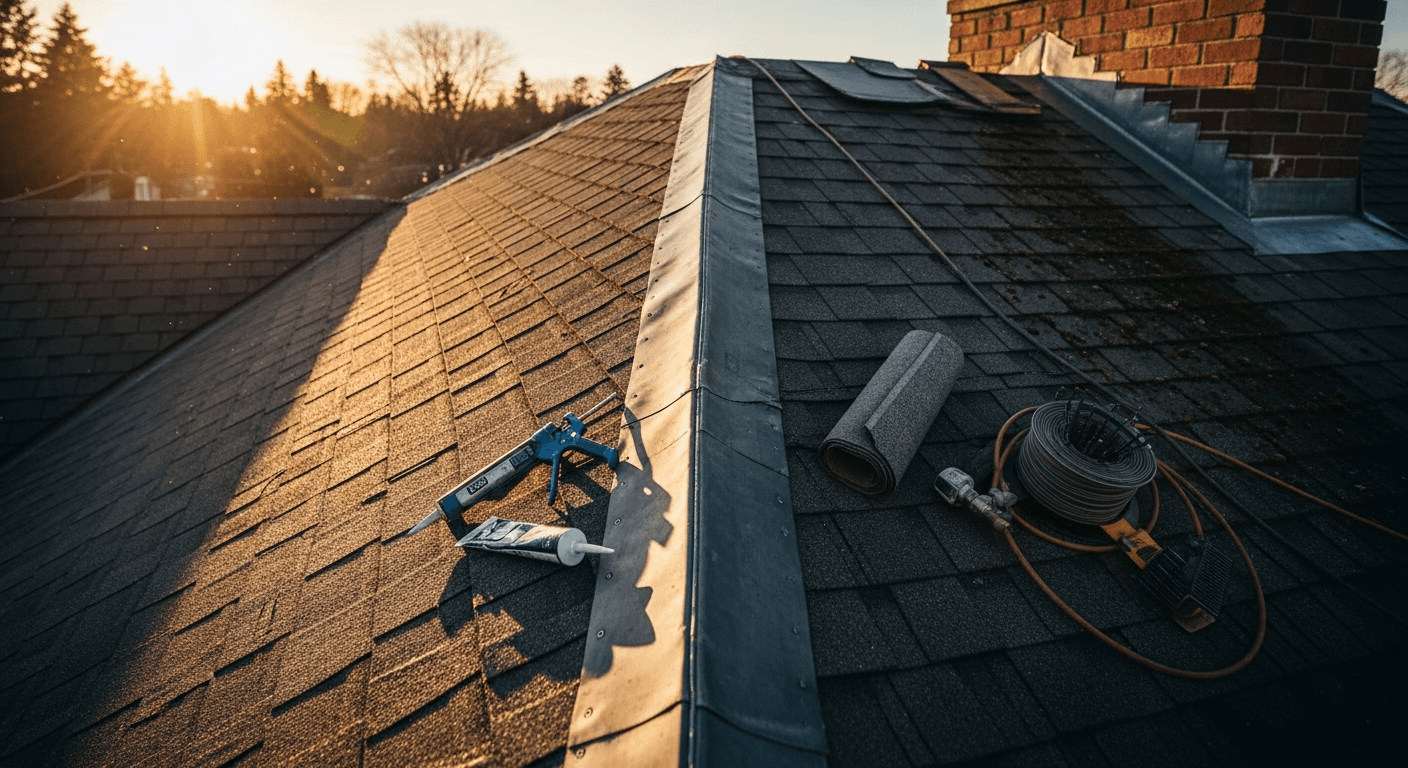

Roofing contractors face IRS audits when they misclassify major roof work as repairs instead of improvements. The difference between immediate deduction and 27.5-year depreciation hinges on three specific tests that most contractors apply incorrectly.
Why roof repair classification matters for your bottom line
The IRS Tangible Property Regulations under Section 263(a) changed how contractors must account for roof work. What used to be professional judgment calls now follow rigid classification rules.
Here's the financial impact: A $50,000 roof replacement classified as a repair gives you an immediate $50,000 deduction. The same work classified as an improvement forces you to depreciate that expense over 27.5 years for residential rental property or 39 years for commercial property according to Madras Accountancy (2026).
That immediate deduction could save you $12,500 in taxes (assuming a 25% tax rate). Misclassify it during an audit, and you face that $12,500 in back taxes plus penalties and interest.
The 3 IRS tests that determine roof work classification
Every roof job must pass through three specific tests. If any test indicates improvement, you must capitalize the entire cost.
Test 1: The betterment test
Betterment occurs when your work increases the value, strength, or capacity of the roof beyond its condition before the damage or wear occurred.
- Installing a higher-grade shingle material than originally used
- Adding insulation or ventilation systems not present before
- Upgrading from 3-tab to architectural shingles
- Strengthening roof structure to handle additional load
Test 2: The adaptation test
Adaptation means modifying the roof for a use that differs from its original intended function.
- Converting a flat roof to a sloped roof system
- Adding solar panel mounting systems
- Installing rooftop equipment platforms
- Creating roof access for new HVAC equipment
Test 3: The restoration test
Restoration involves returning the roof to its ordinary operating condition after it has deteriorated to a state of disrepair.
The key threshold: replacing more than 40% of the roof system typically triggers restoration classification, forcing capitalization even if you use identical materials.
When roof expenses can be deducted immediately vs capitalized
Understanding the line between repairs and improvements protects you from audit penalties. Here's how the classification breaks down in practice.
| Work Type | Classification | Tax Treatment |
|---|---|---|
| Patch 10 missing shingles | Repair | Immediate deduction |
| Replace gutters with identical material | Repair | Immediate deduction |
| Seal minor flashing leaks | Repair | Immediate deduction |
| Replace 50% of roof surface | Improvement (restoration) | 27.5 or 39-year depreciation |
| Upgrade to impact-resistant shingles | Improvement (betterment) | 27.5 or 39-year depreciation |
| Add skylights to existing roof | Improvement (adaptation) | 27.5 or 39-year depreciation |
Documentation that protects you during IRS audits
Proper documentation proves your classification decision to IRS auditors. The burden falls on you to justify immediate deduction claims.
Required documentation includes:
- Pre-work photos showing existing roof condition
- Detailed scope of work describing exactly what you replaced
- Material specifications comparing old vs new components
- Percentage calculations of roof area affected
- Written explanation of why the work qualifies as repair vs improvement
Material cost pressures affecting roof classification decisions
Rising material costs make classification errors more expensive. According to Associated Builders and Contractors, construction material prices increased 3.4% year-over-year as of November 2025. GAF announced 5% to 8% price increases effective April 2026 per Georgia Roof Advisors (February 2026), while CertainTeed announced increases up to 8% for the same period.
These increases affect your classification decisions in two ways:
- Higher material costs make the immediate deduction more valuable
- Pressure to use higher-grade materials to justify pricing may trigger betterment classification
The contractors who document properly keep their deductions. The ones who guess get audited.
Safe harbor elections that simplify roof accounting
The IRS offers two safe harbor elections that can simplify your roof repair classification decisions.
Small taxpayer safe harbor: If your average annual gross receipts for the three prior years don't exceed $27 million, you can elect to deduct improvements up to the lesser of $10,000 or 2% of the building's unadjusted basis.
De minimis safe harbor: Items costing $2,500 or less can be expensed immediately if you have an applicable financial statement, or $5,000 or less without such statements.
These elections must be made annually on your tax return and apply to all qualifying property, not just roofs.
Common mistakes that trigger IRS attention
Three patterns consistently draw IRS scrutiny to roofing contractors:
Mistake 1: Treating total roof replacements as repairs. Replacing an entire roof system always fails the restoration test, regardless of materials used. The IRS sees this misclassification in 40%+ of roofing contractor audits.
Mistake 2: Ignoring the betterment test when upgrading materials. Using better materials than originally installed triggers betterment classification even if the roof area affected is small.
Mistake 3: Failing to separate repair and improvement components. A single invoice combining legitimate repairs with improvement work forces capitalization of the entire amount.
How commercial vs residential classification affects depreciation
The property type determines your depreciation schedule for capitalized roof improvements. Commercial property improvements must be depreciated over 39 years according to Madras Accountancy (2026), while residential rental property improvements spread over 27.5 years.
This difference significantly affects your tax planning:
- A $100,000 commercial roof improvement generates $2,564 annual depreciation
- The same improvement on residential rental property generates $3,636 annual depreciation
- The residential classification provides $1,072 more annual deduction
Mixed-use properties require allocation between commercial and residential portions based on square footage or rental income percentages.
What to do next
Implementing proper roof repair classification protects your deductions and prevents audit penalties:
- Review your last 12 months of roof jobs and verify classification decisions using the three IRS tests
- Create a documentation checklist that captures scope, materials, and affected percentages for every roof project
- Establish separate invoice line items for repairs vs improvements to avoid forced capitalization
- Consider safe harbor elections if your revenue and job sizes qualify
- Train your office staff to recognize classification red flags before submitting tax returns
The difference between a $50,000 immediate deduction and 27.5-year depreciation can save or cost you $12,500 in taxes. Getting the classification right requires understanding IRS rules, not just roofing expertise.
Salisbury Bookkeeping's fractional CFO service handles these classification decisions for roofing contractors every day. We know which documentation the IRS expects and how to structure your jobs to maximize immediate deductions while staying compliant.
BuilderCFO tracks your repair vs improvement expenses in real-time, showing exactly which jobs qualify for immediate deduction and which require capitalization. The dashboard surfaces the documentation you need for audit protection and gives you visibility into your tax planning throughout the year.
Need this handled by someone who does it every day?
Salisbury Bookkeeping is the construction-only bookkeeping + fractional CFO firm that contractors trust to get their books, WIP schedules, and job margins right. And BuilderCFO — our dashboard — gives you real-time job cost visibility, 13-week cash forecasting, and a margin-by-job view in one screen.
See how Salisbury Bookkeeping helps contractors like you → · Try BuilderCFO →
Frequently Asked Questions
- What percentage of roof replacement triggers improvement classification?
- Replacing more than 40% of a roof system typically triggers the restoration test, requiring capitalization even when using identical materials.
- Can I deduct roof work immediately if I use the same materials as before?
- Not necessarily. The restoration test focuses on the extent of work, not material type. Extensive replacement using identical materials still requires capitalization.
- How do safe harbor elections affect roof repair deductions?
- Small taxpayers can elect immediate deduction for improvements up to $10,000 or 2% of building basis, whichever is less, regardless of repair vs improvement classification.
- What documentation do I need to support repair classification during an audit?
- Pre-work photos, detailed scope descriptions, material specifications, percentage calculations of affected area, and written classification justification.
- How does property type affect roof improvement depreciation?
- Commercial property improvements depreciate over 39 years while residential rental property improvements use 27.5 years, creating different annual deduction amounts.
- Can I separate repairs and improvements on the same roof job?
- Yes, but they must be invoiced separately. Combining repair and improvement work on one invoice forces capitalization of the entire amount.
- What triggers the betterment test for roof work?
- Using materials that increase roof value, strength, or capacity beyond the original condition, such as upgrading from 3-tab to architectural shingles.
- Do material cost increases affect repair vs improvement classification?
- No, classification depends on the nature of work performed, not material costs. However, higher costs make proper classification more financially important.
Book a free 30-minute call.
You walk away with a list of leaks in your books. Free. No pitch.
Book a free call